

Hi, for those new here, I’m Leslie, and I’m a product designer. I’ve spent the last decade-plus building with early-stage startups and larger tech teams. Now, I run & luo studio, as a fractional product design partner for teams building meaningful experiences.
In June, alongside the Biographer team, we launched Postcards, a social media app for real friends that captures your day-to-day through voice memos and postcards, minus the ads and addiction.
At the same time, the team also worked on the latest iteration of Biographer: an AI memoir-writing companion that captures your life’s story to share with friends and family.
Biographer started because Jared Hecht wanted to find a way to document his father’s life. His father had been diagnosed with a terminal illness, and Jared was inspired by his mother, who had once sat down with her mother to record her talking about her life. So he and his co-founder, Averyan Turetsky, decided to figure it out together. I’ve been lucky to be part of the journey to design the experience since the start.
In its latest iteration, Biographer moved from a voice-call, screenless experience to a responsive web app. The team used my cobbled-together Figma UI kit and fed it into Claude Design (which had recently launched) to generate the entire interface. It shipped. People were signing up when we announced the launch. When I came back to designing Biographer after Postcards, I looked at a product built end-to-end without a (human) designer.
So the question became: what exactly is my role here?
Coming in after
Nobody on the team knew exactly what to hand me. So, I dived in and used Biographer as a real storyteller. I went through every flow, pulled data from PostHog, and wrote a comprehensive audit to guide what to fix now and what to rethink as a starting point for next steps.
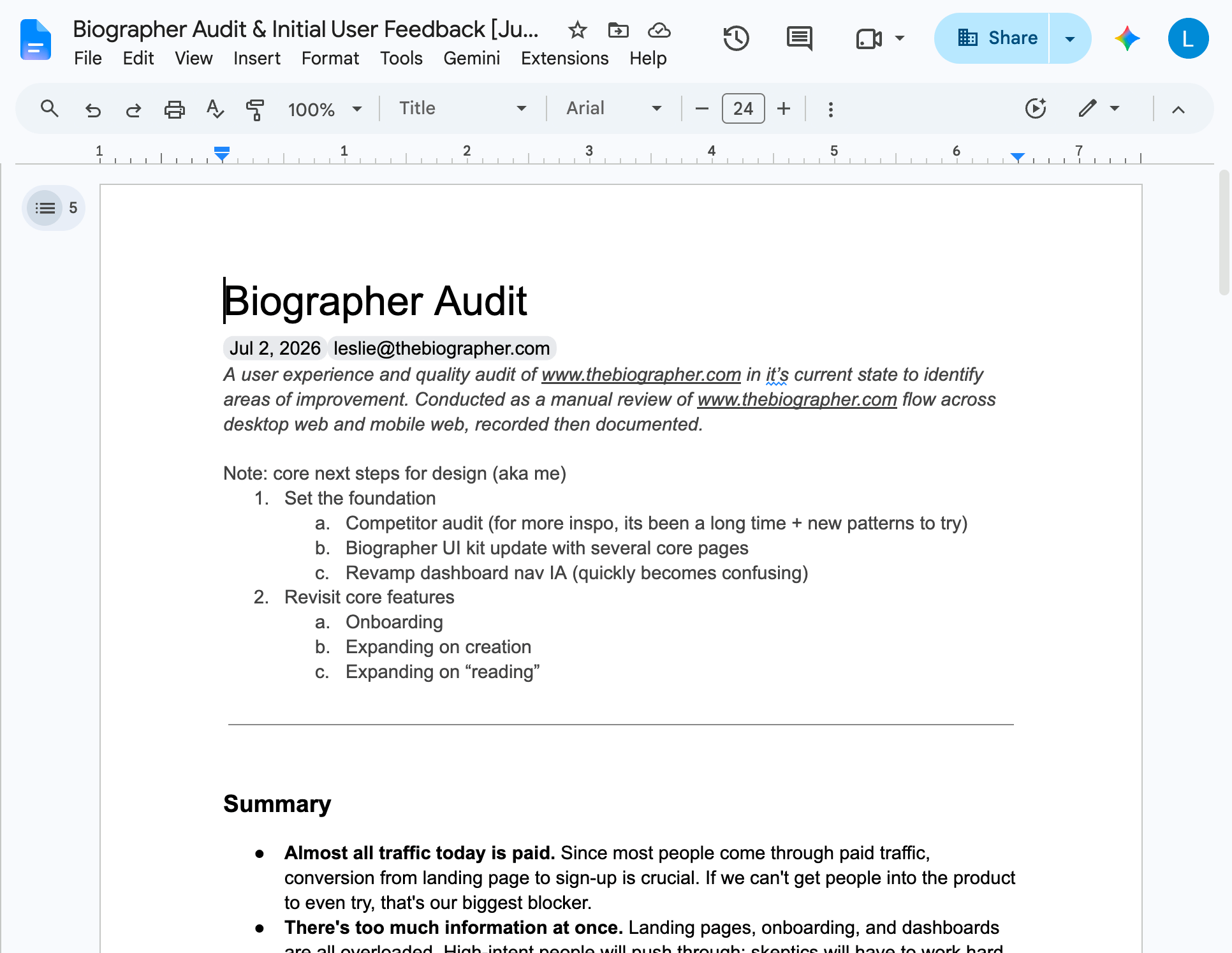
The team was already shipping fast. My job wasn’t to slow that down. Instead, it was to figure out where design attention would matter most, and let everything else be a quick launch and learning opportunity.
How the work actually happens
The way I work has shifted over the past year, and even in the last few months, and it’s worth sharing for anyone else navigating this shift.
My core tools are no longer mainly Figma and Google Docs. I start in the codebase. I open Cursor and read through the production code to understand what’s built, how things connect, and the constraints. Then I pull data from PostHog, use Claude to synthesize what I’m seeing, and write a brief. By the time I’m designing, I know what exists, what the data says, and what the team is trying to solve pretty independently. Sometimes I design in Figma. Sometimes I skip it entirely and go straight to code.
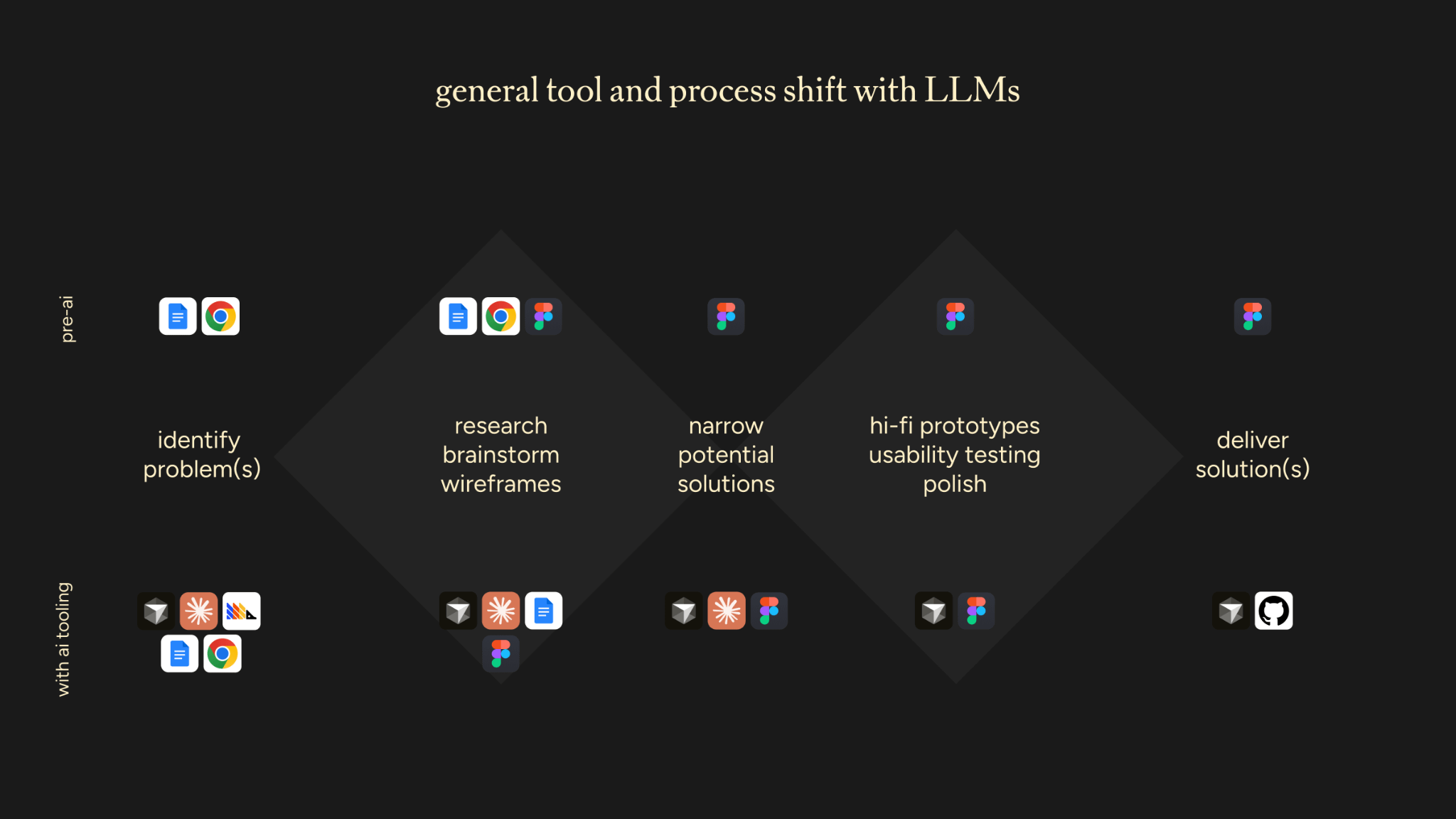
After the initial Biographer audit, I refreshed the overall UI in Figma, but those frames were just starting points to guide where we could go. The more “traditional” design work still mattered, like rethinking the dashboard entirely when the team realized small tweaks didn’t make sense for a product with real questions about whether it should behave like a classic dashboard tool or a companion. But increasingly, the work happened in code.
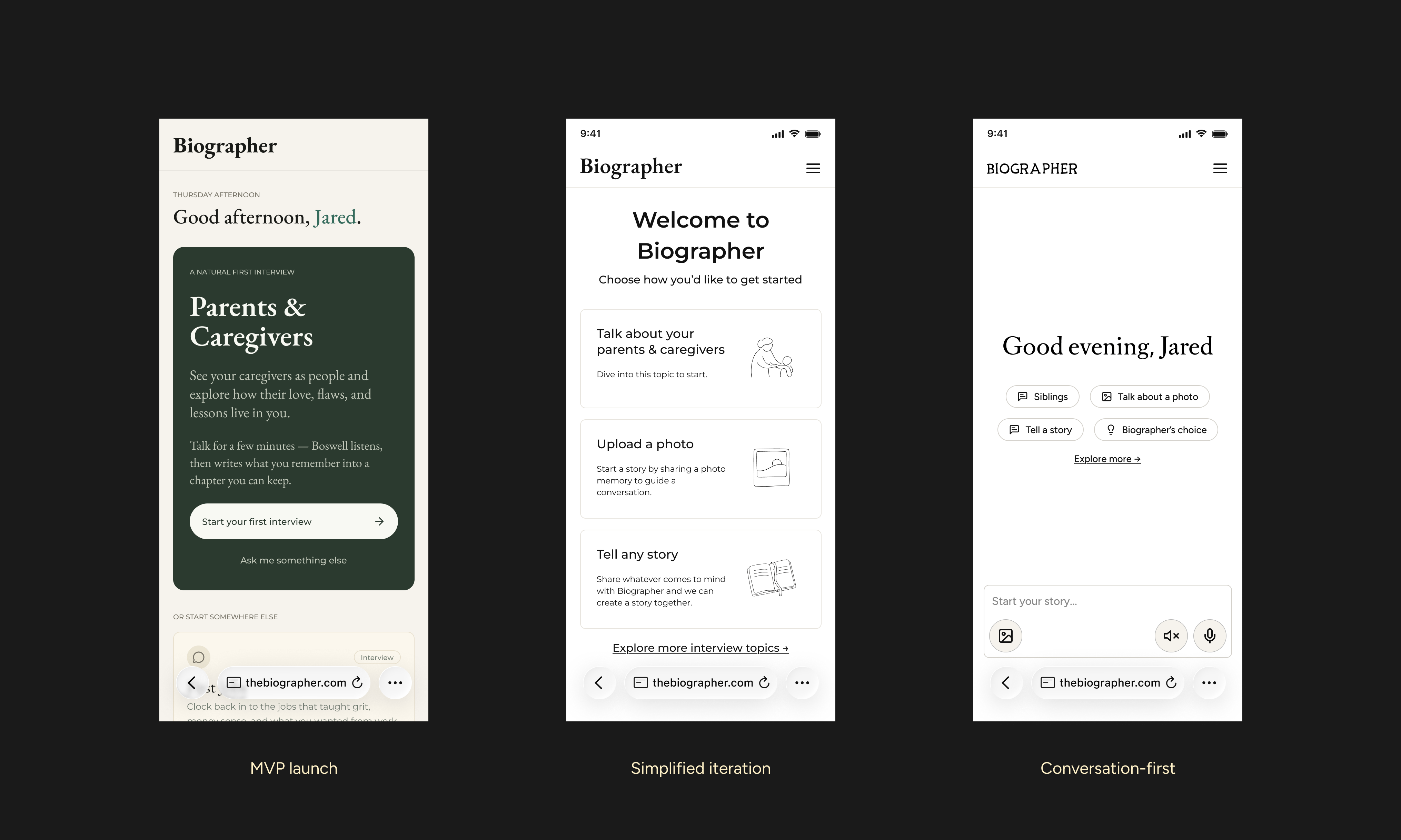
I made my first production deploy on July 28th. By September, shipping code was my default mode. For fairly simple and straightforward features or quick fixes, I build them myself and open a PR for review. For technically complex experiences, I design core screens and share them with engineering so we can partner and decide together whether I should tackle some or all, and hand off if I need help. And, of course, I can now take front-end-heavy features to production with my detailed design lens, reducing the previous back-and-forth, especially on visual and motion polish.


My work isn’t about replacing engineers; it’s about seeing where our expertise and interests lie and finding ways to bring more of our skills to improve the product development process without being a gatekeeper, blocker, or silo.
The team trusts me to ship, and I trust them to build. I give them UI kits and design systems so they can move without looping me in on every screen. They give me codebase access and review so I can go from idea to production with minimal back-and-forth handoff where appropriate.
What happened when we focused
July was loud. We launched, and people showed up. But we kept seeing people sign up and then drop off. The interest was real, but the follow-through wasn’t. So we had to ask ourselves: how do we get the right people in the door, and how do we make writing a story so easy and delightful that they stay?
We simplified. We rethought the product architecture. I asked why each story wasn’t its own thread, and the team made the change the next day. Now every story is its own conversation, and each becomes a chapter in your book. We merged separate creation modes into one page, removed features that split attention, and relaunched the stories page to make browsing easier. Less to figure out, more people getting to what actually matters: their story.
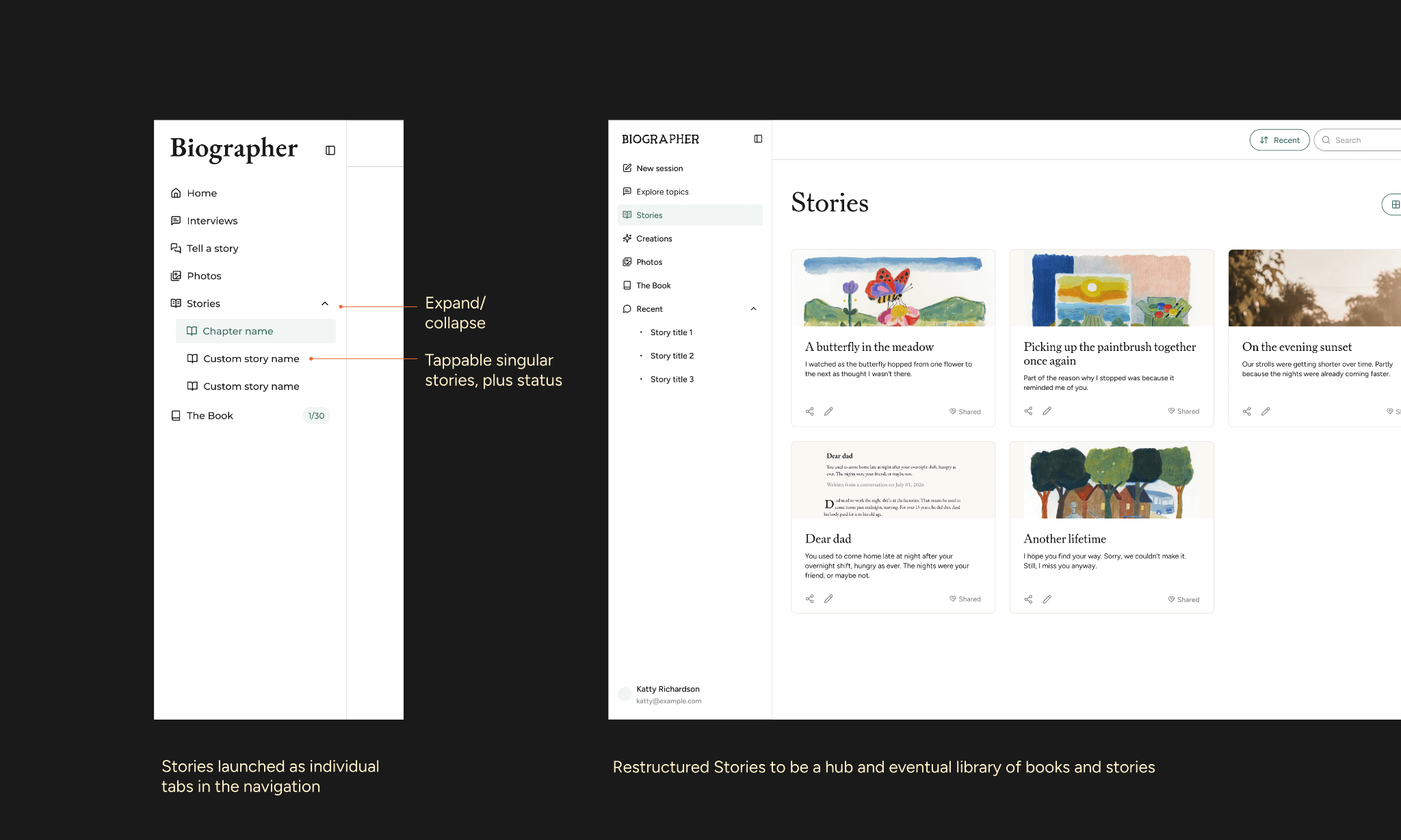
The book
The part of Biographer I’ve focused on most lately was the book. This is where every story, every chapter, every conversation lands: a real, printed hardcover you can hold in your hands and give to someone you love.
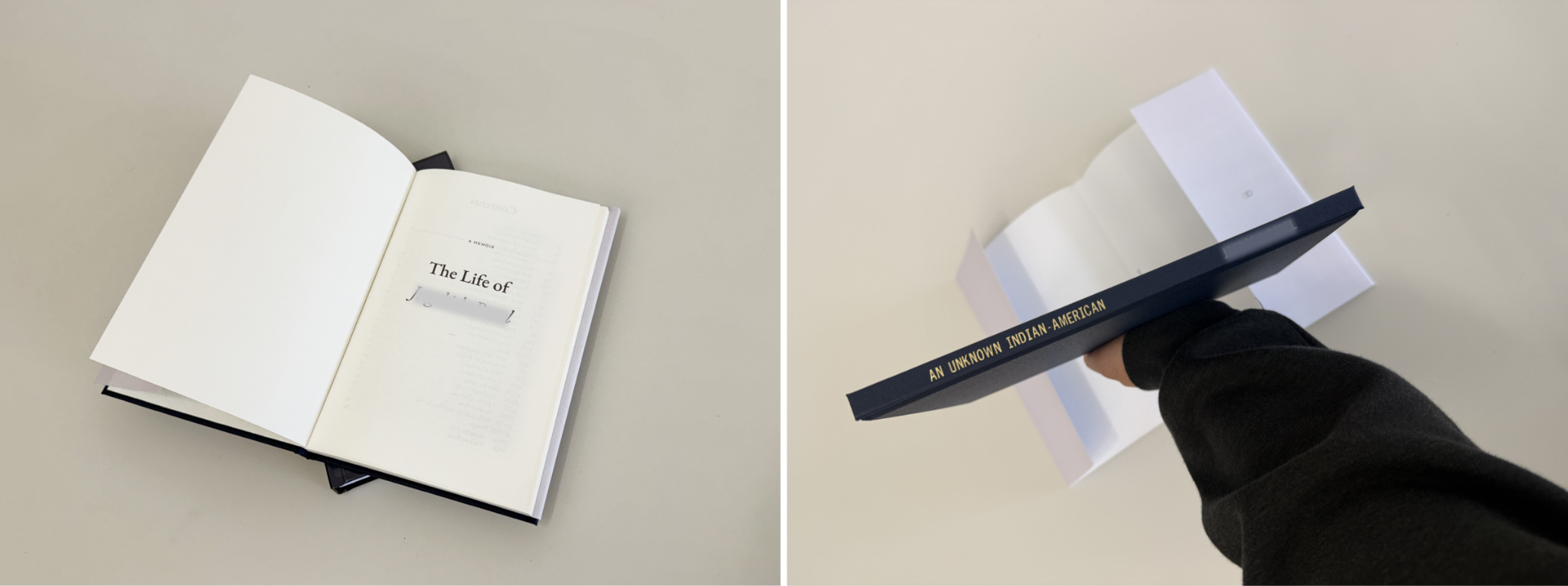
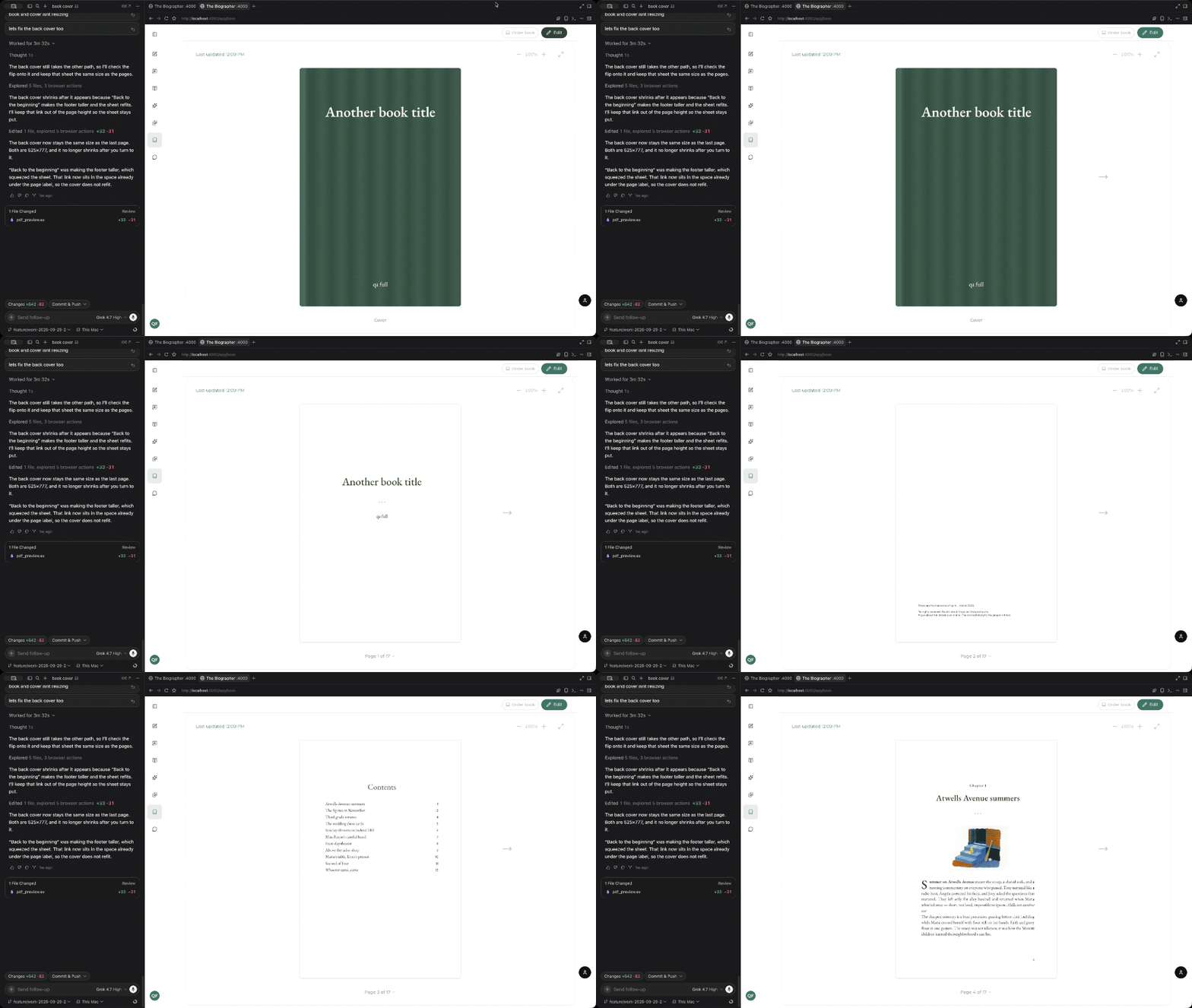
I designed and built the book cover editor in Cursor where storytellers can choose a cloth color, style their title and byline, and upload a cover photo. It feels close to the real physical product, so people know what to expect. Cursor/LLMs helped me read through our print API docs to understand the physical constraints. I then built the front end with Cursor and launched improvements within a week.
This is what makes Biographer click for me. You can talk to an AI companion all day, but at some point you need to hold the result. A book on a shelf is something your kids will find someday and hold on to forever.
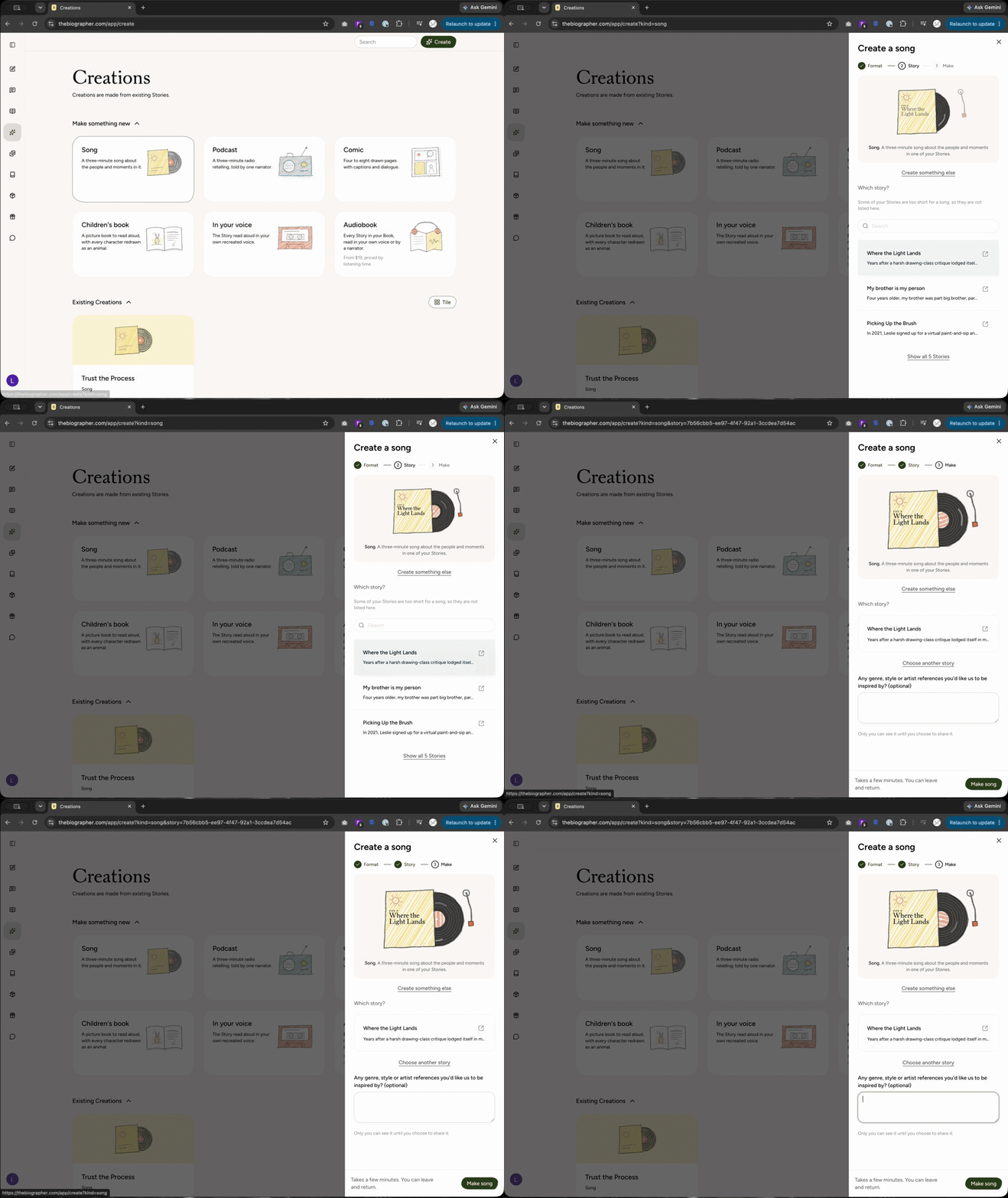
The team is also moving full speed on Creations, where you can turn any story into a song, a comic, a podcast, a children’s book, or an audiobook read in your own voice. Not everything needs a designer to figure out. The team runs with their ideas, I reworked the creation flows for clarity, and we launched together. It’s been exciting to see an idea turn into a real experience, quickly and thoughtfully.
So far
If you read my Postcards piece, you might remember I wrote that I still need to make something I’m proud of at the end of the day, and that can be from using an AI tool or simply from my own brain. I still believe that. But “making it” means something different now than it did even four months ago. It’s about building a product that works for the person using it, one I’ve helped shape from vision to design and now, code.
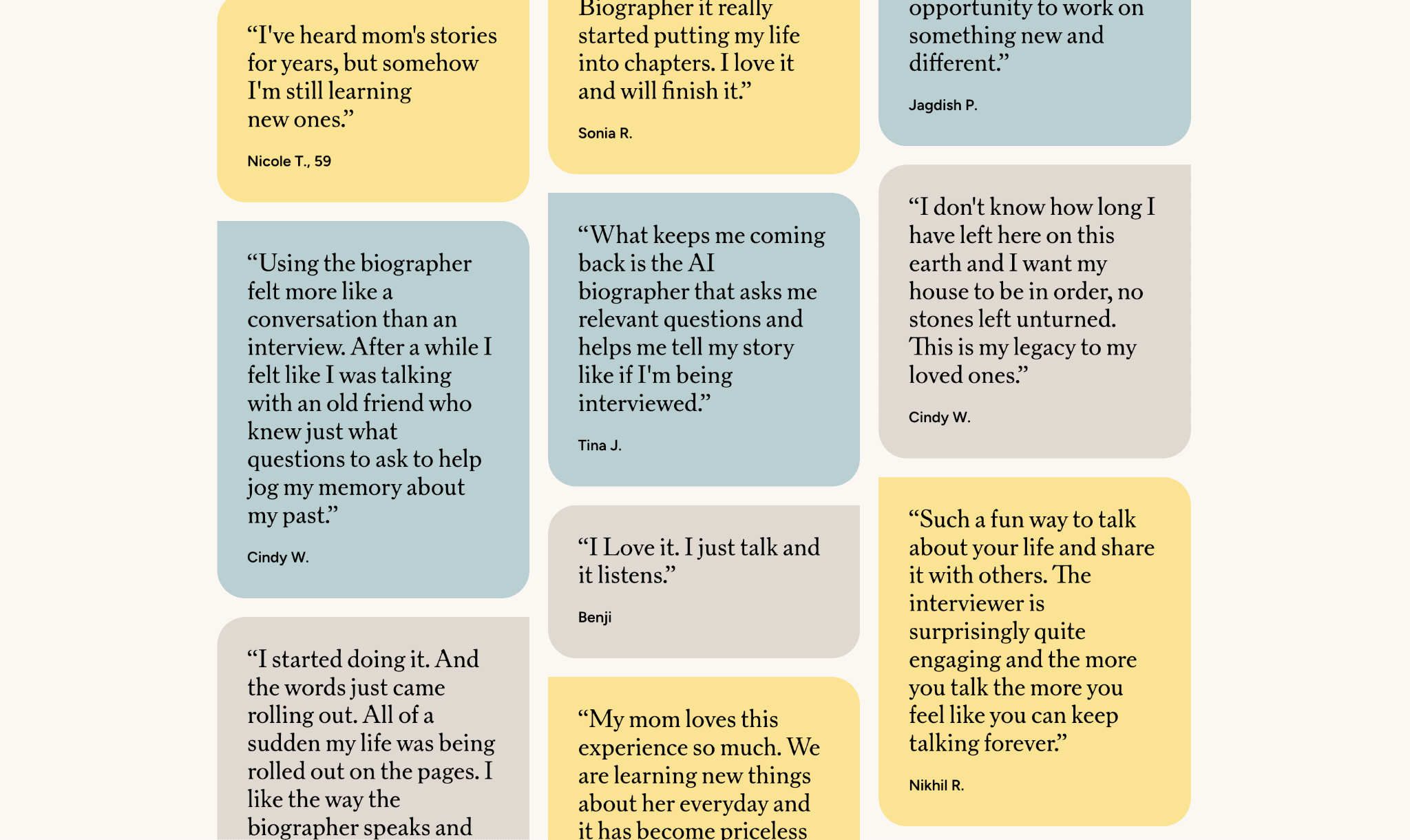
And more importantly, people now have a tool that helps them write. People use it to grieve, process, and leave something behind. One storyteller said, “I keep using [Biographer] because I have someone to talk to that doesn’t judge me for the bad things I’ve done.” Another storyteller shares that “the words just came rolling out. All of a sudden my life was being rolled out on the pages.” And another shares that she’s lost her son and is now writing his story so his daughter will have it.
These reasons aren’t about the perfect AI tool, product metrics, or pixel-perfection; they’re about real people sharing real stories and finding continuous meaning in lives well lived. That’s the point.
Try Biographer
Biographer is free to start. Talk with your biographer and write your first stories. Your first 5 creations are free too: turn any story into a song, comic, podcast, children’s book, or audiobook. And when you’re ready, you can also order a printed hardcover of your book.
We’re also looking for a growth and product marketing leader to take Biographer to the next level. If that’s you, say hi at hello@thebiographer.com.
Let’s work together
If you’re a founder or a small team building something meaningful and looking for a design partner who works like this — embedded, opinionated, comfortable building in ambiguity — I’d love to hear from you. I run & luo studio, and you can reach me at leslie@andluo.studio.